

| The short answer: AI will not replace lawyers wholesale — but it is already automating entry-level legal tasks and displacing junior roles at some firms. The lawyers at risk are those who refuse to adapt. The lawyers who thrive will be those who use AI to do more, not fewer, of the things that made them choose law in the first place. |
The question of will ai replace lawyers has been generating anxiety in law schools and law firms since ChatGPT passed the bar exam in 2023. In 2026, we have enough real data to give you an honest answer — not the reassuring one or the catastrophist one, but the accurate one.
This guide answers will ai replace lawyers by looking at what is actually happening right now: which legal tasks are already automated, which roles are genuinely at risk, what the employment data actually shows, and — most importantly — what every lawyer should be doing today to stay ahead of this shift.
1. What the Data Actually Says in 2026
The data on will ai replace lawyers tells a more nuanced story than either the doom predictions or the reassurances suggest. Here is what we know from verified 2026 sources.
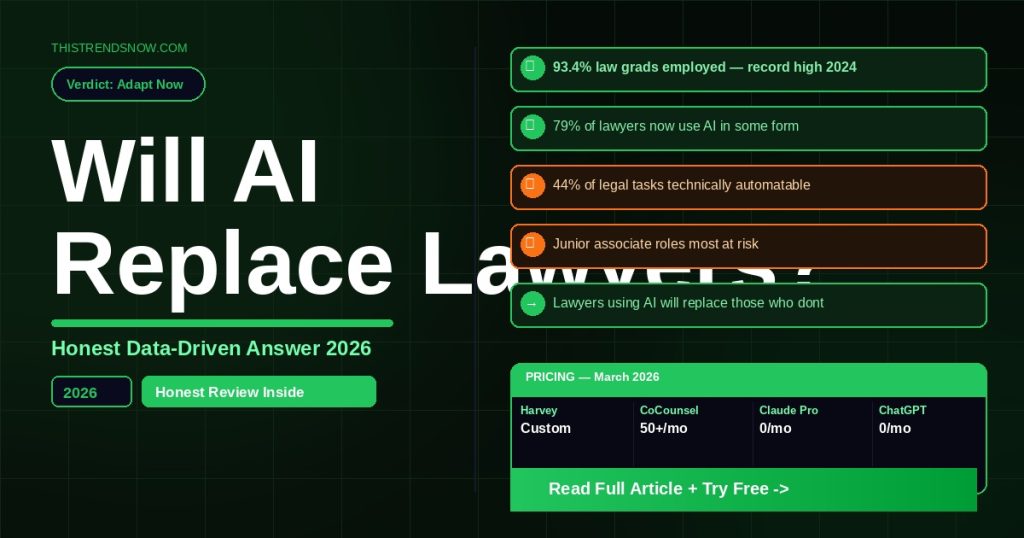
- 93.4% of law school graduates in 2024 were employed within 10 months — the highest rate on record
- McKinsey estimates 22% of a lawyer’s current tasks can be automated today, rising to 44% as technology matures
- 79% of legal professionals now use AI in some form — up from 23% just two years ago
- Harvard Law found none of the AmLaw 100 firms plan to reduce attorney headcount despite 100x productivity gains on specific tasks
- Law firms with wide AI adoption are nearly three times more likely to report revenue growth than those without
The picture is not mass displacement — it is transformation. The profession is not shrinking. It is changing what the work actually involves.
2. Which Legal Tasks AI Is Already Automating
These are not future predictions. These are tasks being automated at law firms right now in 2026.
Document Review and eDiscovery
AI can sift through millions of documents, emails, and contracts in hours — identifying relevant keywords, flagging privileged information, and determining document relevance. This used to require teams of junior associates billing thousands of hours. AI now does it faster and with fewer errors.
Contract Analysis and Drafting
AI tools can review contracts, flag unusual clauses, identify regulatory conflicts, and draft standard agreements from templates in minutes. Law firms using AI for contract work report completing tasks in a fraction of the previous time. Clients increasingly expect this efficiency — and are less willing to pay billable hours for tasks AI can complete faster.
Legal Research
Tools like Harvey, CoCounsel, and LexisNexis Protégé can conduct comprehensive legal research, synthesise case law, and identify relevant precedents across jurisdictions in minutes. What used to take a junior associate a full day now takes an AI agent under an hour.
Routine Document Generation
Wills, standard leases, NDAs, employment contracts, incorporation documents — AI generates these from templates with high accuracy. Online legal services are offering these documents directly to consumers at a fraction of traditional legal fees, bypassing lawyers entirely for straightforward matters.
3. Which Legal Roles Are Most at Risk
The honest answer to will ai replace lawyers at the role level is: junior associates doing routine document work face the highest risk. Senior lawyers who apply judgment, manage client relationships, and handle novel legal questions face much lower risk.
- High risk: Junior associates doing document review, contract drafting, and legal research
- High risk: Paralegals handling routine document preparation and administrative legal tasks
- Medium risk: Mid-level associates at firms slow to adopt AI — they will be outcompeted by AI-augmented peers
- Lower risk: Senior partners with deep client relationships and specialised expertise
- Lower risk: Litigators who argue in court — judges have not yet permitted AI to argue cases
- Lower risk: Lawyers in emerging practice areas: AI regulation, data privacy, ESG compliance
| The key insight: AI is not replacing lawyers — it is reducing the number of junior lawyers needed to do the same amount of work. If one AI-augmented lawyer can produce the output of three junior associates, firms will hire fewer junior associates. The profession is not disappearing. The entry path into it is narrowing. |
4. Why AI Will Not Replace Lawyers Entirely
There are fundamental limits to what AI can do in legal practice right now — and several of them are structural rather than just technical.
Legal Judgment Cannot Be Automated
The New York State Bar Association’s Task Force on Artificial Intelligence has been explicit: AI lacks the legal judgment, contextual understanding, and professional responsibility that experienced lawyers provide. AI can hallucinate case citations, misstate holdings, and fail at applying jurisdiction-specific standards. Human oversight is legally and ethically nonnegotiable.
Professional Responsibility
An AI tool is not licensed to practice law and cannot be. Professional conduct rules — including competence, confidentiality, and independent judgment — require a licensed human lawyer to take responsibility for every piece of legal advice given. This is not changing in 2026.
Client Relationships
Legal work at senior levels is fundamentally about trust built over years. Clients hire lawyers for results, judgment, and accountability — not for document drafting. AI can assist with the drafting. It cannot replicate the relationship, the credibility, or the accountability.
5. Will AI Replace Lawyers — The Entry Level Problem
The most honest answer to will ai replace lawyers focuses on entry level. Harvard economist David Deming has noted that AI is best suited to tasks typically assigned to junior professionals: synthesising documents, drafting summaries, producing routine filings. This is precisely the work that used to train lawyers in their early years.
The profession is already seeing this pattern. According to The Atlantic, law is among several professions seeing declining entry-level job offers even as senior positions remain stable. Some firms are making do with smaller associate classes. The training pipeline for the next generation of senior lawyers is under pressure — not because senior lawyers are being replaced, but because the junior-to-senior pathway is narrowing.
6. How Lawyers Are Using AI to Win More Work
The lawyers winning in 2026 are not the ones ignoring AI — they are the ones using it to do more than they could before. According to the Legal Trends Report, legal professionals using AI reported improved work quality (65%), better client responsiveness (63%), and increased work capacity (54%).
- Taking on more matters per person — AI handles the routine work, lawyers handle the judgment
- Competing for work previously out of reach — smaller firms accessing the same research tools as elite firms
- Offering value-based pricing — when AI completes in minutes what used to take hours, clients benefit directly
- Expanding into new practice areas — AI regulation, data privacy, ESG compliance are growth areas
- Improving client communication — faster responses, better-prepared documents, fewer errors
7. The Best AI Tools for Lawyers in 2026
For lawyers asking will ai replace lawyers the more useful question is: what AI tools should I be using right now to stay ahead? Here are the tools legal professionals are using most effectively.
| Tool | Use Case | Price | Official Link |
| Harvey AI | Legal research, contract analysis, document drafting | Custom enterprise pricing | harvey.ai |
| CoCounsel (Thomson Reuters) | Legal research, document review, deep research mode | From $150/user/month | legal.thomsonreuters.com |
| Clio Duo | Practice management AI, matter insights, client communication | Included in Clio plans from $49/month | clio.com |
| LexisNexis Protégé | Multi-agent legal research and analysis | Custom pricing | lexisnexis.com |
| Claude Pro | Document analysis, contract review, long-form drafting | $20/month | claude.ai |
| ChatGPT Plus | General legal research, drafting, client communication templates | $20/month | openai.com/chatgpt |
| Important: General AI tools like Claude and ChatGPT are useful for drafting and research but require careful verification. They hallucinate case citations and legal holdings. Always verify any AI-generated legal research against primary sources before relying on it. |
8. How to Adapt and Stay Relevant
The answer to will ai replace lawyers is ultimately in your hands. As Thomas Officer of The Colleges of Law puts it: AI will not make lawyers obsolete, but lawyers who do not use AI will be made obsolete by lawyers who do.
Here is the practical adaptation plan for lawyers at every career stage.
If you are a law student or junior associate
- Learn AI tools now — not as a curiosity but as core professional competence
- Focus on skills AI cannot replicate: judgment, client relationships, courtroom advocacy, creative problem-solving
- Seek out firms actively investing in AI — they will grow; firms ignoring it will shrink
- Consider specialising in emerging areas: AI law, data privacy, algorithmic accountability
If you are a mid-level or senior lawyer
- Audit your current workflow — identify the tasks consuming most of your time that AI could handle
- Trial Claude Pro or CoCounsel on your actual work — not hypothetical tasks but real matters
- Reframe your value proposition: you are not being paid to draft contracts — you are being paid for judgment, accountability, and results
- Update your billing model: outcome-based pricing is growing; clients increasingly refuse to pay hourly for tasks AI can do in minutes
| The bottom line: AI is not coming for lawyers. It is coming for the parts of legal work that never required a lawyer’s judgment in the first place. The lawyers who embrace this shift will work less on the tedious parts and more on the work that attracted them to law. That is not a threat — it is an opportunity. |